Case study · Platform lifts, stairlifts and hoists · Gravesend, Kent
From sub-contract work to a pipeline Reed owns.
Reed Lifts installs platform lifts, stairlifts, through-floor lifts and hoists across Kent and South East London. It still sub-contracts for the biggest names in the sector. It now wins direct work as well.
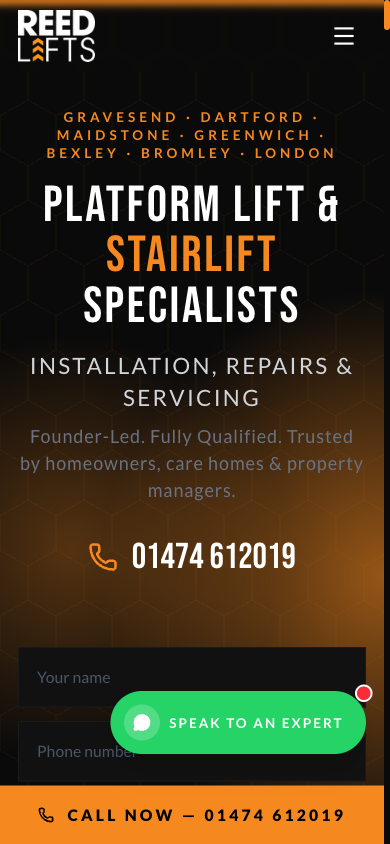
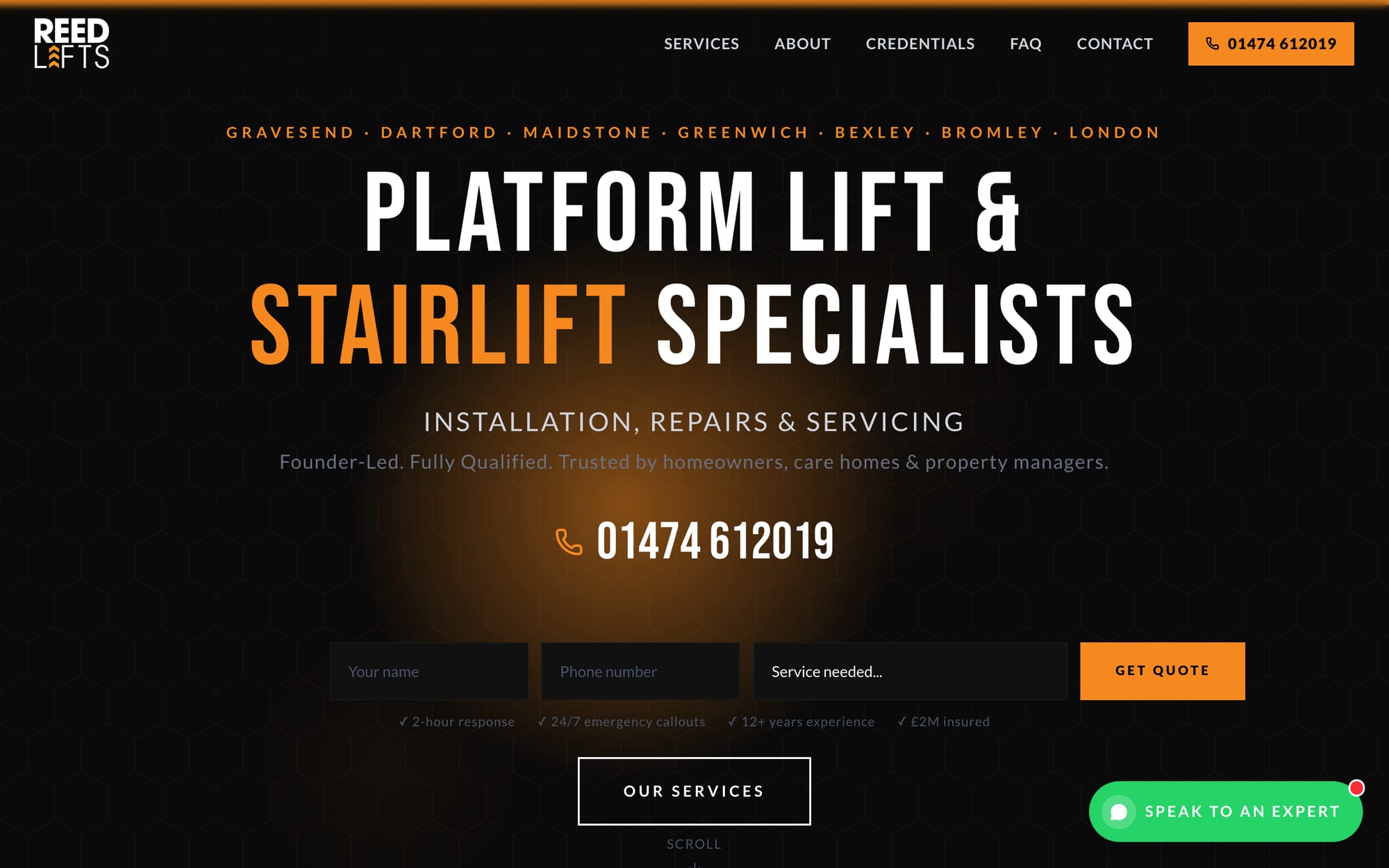
(Where this started)
Reed Lifts was cash-flow positive on sub-contract work for the biggest names in the sector. The problem was that the pipeline lived on somebody else’s phone. When the larger firms went quiet, the work stopped. A few direct jobs had come in off the back of LinkedIn, but there was nowhere to send anyone who got curious, so every direct lead was an accident nobody could repeat.
The business was not broken. It was invisible to the people who would have paid the most for it. Everything below is the work of making it visible, in the order it was done.
(Where it got to)
0jobs
Booked in the first two months
£1-8k
Value per job
0of 8
From one post, one decision maker
0.0
Google rating, 9 reviews
Figures from Reed Lifts: LinkedIn analytics for the 90 days shown, and the live Google Business Profile. Job numbers and values reported by the founder.
Read those numbers properly. Four of the eight jobs came from one decision maker, so this is five buyers rather than eight, and one of them was worth four jobs on his own. That is what being findable by the right person in a small industry is worth.
One business, ninety days, every number sourced above. That is the entire evidence base and all of it is on this page.
(What we actually did)
Find the position
Work out what the business can credibly become known for.Mapped where work actually came from: sub-contract for United Lift Services, The Platform Lift Company and Only Lifts, with no direct channel of their own.
Narrowed the positioning to platform lifts, the highest-value work Reed does and the one it can genuinely claim to specialise in.
Separated the buyer groups, because a homeowner installing a through-floor lift and a contractor specifying a platform lift need to believe completely different things.
Found the local search demand around Kent and South East London that no competitor was answering properly.
Build the proof
Turn the position and the completed work into something buyers can trust.A new site in fourteen days, mobile first, because every trade enquiry comes from a phone in the back of a van.
Service pages for platform lifts, stairlifts, through-floor lifts, hoists and LOLER, each carrying its own compliance language and its own search intent.
A partner strip naming the firms that already trust them, so the credibility comes from the industry rather than from a claim about themselves.
WhatsApp wired to the business line and click-to-call above the fold, because contractors mid-job want an answer in thirty seconds, not a contact form.
A QR code for the van and printed cards that goes straight to the Google review form, plus the Google Business Profile set up properly.
Publish the expertise
Put what the founder already knows in front of the market every week.A weekly rhythm in Harry’s voice, built out of what he already knows about lifts rather than generic trade posts.
The posts that worked were the ones only a lift engineer could have written: faults, compliance, and what goes wrong on site.
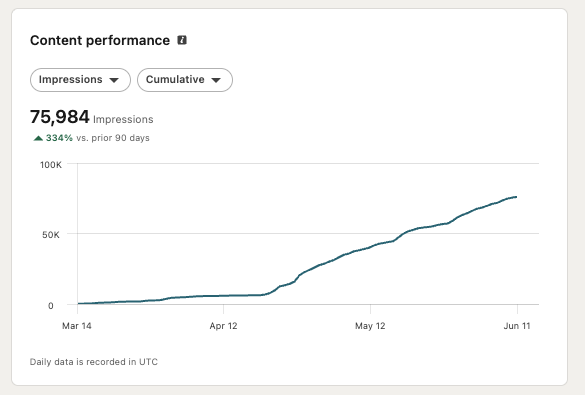
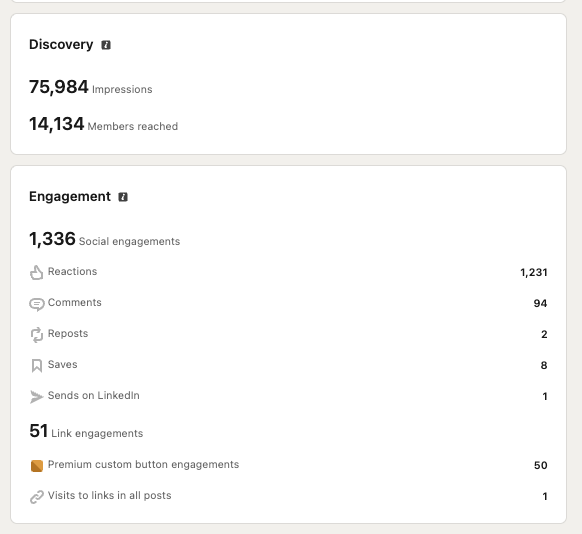
75,984 LinkedIn impressions across 90 days, up 334%, reaching 14,134 people inside and around the lift industry.
None of it depended on Harry finding a spare evening. He is on site most weeks, and it kept shipping anyway.
Grow direct demand
Turn that visibility into enquiries that come to you directly.Eight jobs booked in the first two months at £1,000 to £8,000 each. Four of them came from a single post, from one decision maker in Kent.
Nine Google reviews from a standing start, holding a 5.0 rating, so the search result carries proof as well as a phone number.
The first direct pipeline the business has had. Reed still takes sub-contract work, and now it does not depend on it.
(The proof, straight from LinkedIn)
Ninety days of the content engine, in Reed's own analytics: 75,984 impressions, up 334%, and 14,134 people reached. That is the audience the direct jobs came out of.
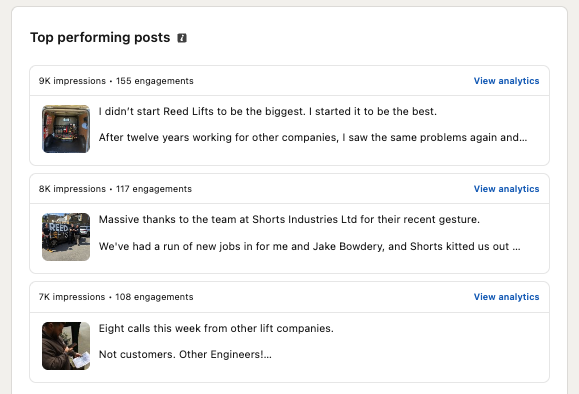
“Eight calls this week from other lift companies. Not customers. Other Engineers.” One of Reed's top posts. The industry started paying attention before the buyers did.
(What else it pulled in)
Industry press, inbound
The editor at Lift Industry News asked for a feature interview on Reed Lifts as a new entrant in the sector. Nobody pitched for it.
A supplier partnership, inbound
A supplier sent workwear and tools after seeing the content, then the thank-you post did numbers of its own.
“Sam’s my man in the chair. Web, content, AI, the lot.”
(What it was built on)
The stack matters far less than the decisions above it. It is here because Reed owns all of it and can hand it to anyone.
(The same work, for you)
Reed is one business. What it shows is what this produced on a firm that already did good work and had no way of proving it to anyone outside its existing contacts.
Map the fastest route to more work.
A short call to work out whether trade partnerships, proof, conversion or a commercial pipeline is the first constraint. Fifteen minutes, prices already on the site.